


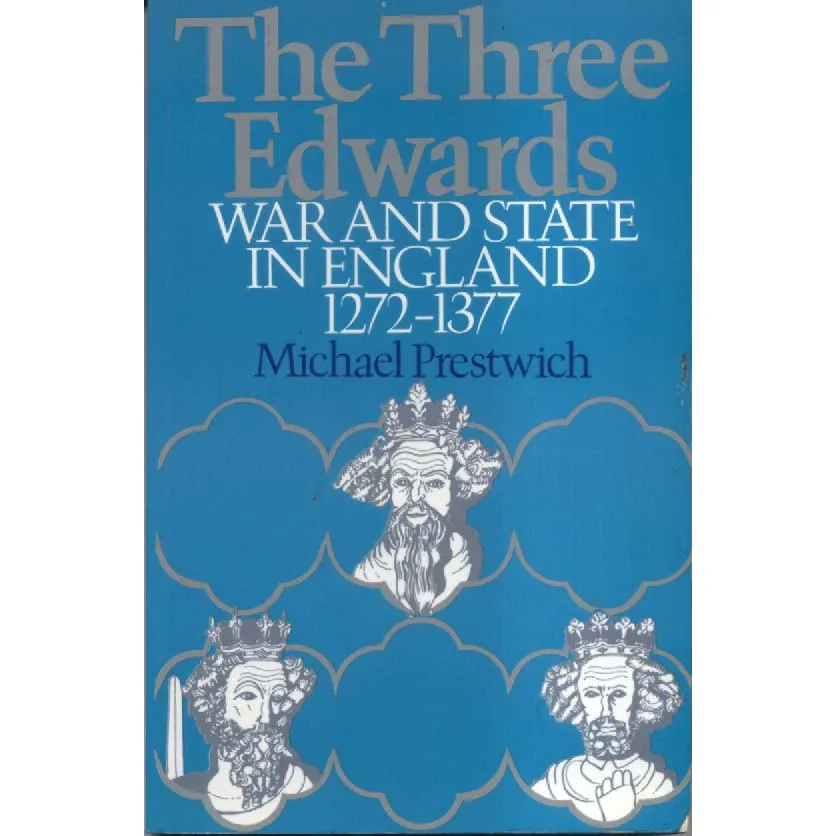
The Three Edwards - War And State In England 1272-1377
Publisher: Routledge
Format: Paperback
ISBN: 9780415051330
There are dynasties that leave behind elegance, poetry, and refined cultural achievement. And then there are the three Edwards, who mostly left behind castles, taxation records, military campaigns, constitutional tension, and large numbers of dead Scots and Frenchmen.
The Three Edwards – War and State in England 1272–1377 by Michael Prestwich is a magnificent deep dive into one of medieval England’s most relentlessly energetic periods, when three successive kings named Edward attempted to govern, conquer, tax, administrate, centralise, and occasionally survive the political consequences of their own ambitions.
Which, as Prestwich demonstrates in excellent detail, turned out to be quite a lot for everyone involved.
Covering the reigns of Edward I, Edward II, and Edward III, the book explores how medieval England evolved into a more sophisticated and militarised state during a century dominated by war. Castles rose, bureaucracies expanded, armies marched, parliaments grew in importance, taxes multiplied, and somewhere in the middle of it all ordinary people were presumably trying to get on with farming while kings developed increasingly expensive strategic visions.
And this is where the book becomes wonderfully ironic.
Modern people often imagine medieval kingship as glorious pageantry involving crowns and tournaments. Prestwich reveals it was also fundamentally an administrative exercise fuelled by paperwork, finance, logistics, and increasingly desperate efforts to pay for campaigns in Scotland and France. Behind every shining knight stood several exhausted clerks attempting to calculate grain supplies.
Edward I emerges as the terrifyingly competent “Hammer of the Scots”, effectively trying to turn England into a disciplined war machine while simultaneously bullying neighbouring kingdoms with the energy of a man who regarded borders as administrative suggestions. Edward II then demonstrates what happens when a highly militarised political system encounters a king less naturally suited to competent rule. Edward III, meanwhile, launches England into the early phases of the Hundred Years’ War and rediscovers the national joy of expensive continental conflict.
The result is a century that feels astonishingly modern in some ways. Prestwich shows how warfare drove state development, taxation, administration, political negotiation, and national identity. Medieval kings did not merely fight wars. They built systems to sustain wars, and those systems gradually reshaped England itself.
One of the great pleasures of the book is the sheer texture of medieval governance. Prestwich handles campaigns, politics, diplomacy, aristocratic rivalries, military organisation, and finance with enormous authority, revealing how deeply interconnected everything was. Castles required money. Armies required administration. Kings required consent, at least occasionally. And everyone required taxes from increasingly irritated subjects.
There is also something deeply funny about the dynastic naming situation. Three successive Edwards spanning more than a century creates the impression medieval England had simply stopped trying creatively. Historians compensate by assigning them dramatic reputations instead: the conqueror, the disastrous one, and the warrior king.
Prestwich writes with the calm precision of a historian who genuinely understands the machinery of medieval politics rather than merely the romantic surface. This is not a book of simplified battlefield anecdotes. It is serious medieval history, rich with administration, military structure, and political complexity. Readers hoping for endless sword fights will instead receive taxation systems, supply problems, feudal tensions, and the astonishing logistical difficulty of invading Scotland repeatedly.
Which is honestly much more interesting.
This Routledge edition remains an excellent academic history volume, substantial and authoritative without becoming unreadable. It carries the satisfying weight of proper scholarship and looks exactly like the sort of book owned by someone capable of discussing fourteenth-century military finance voluntarily.
Condition is listed as Good, meaning this copy has survived the usual hazards faced by serious medieval history: underlining beside passages on feudal obligations, tea consumed near maps of Scottish campaigns, and readers repeatedly losing track of which Edward is currently invading whom.
An outstanding read for medieval-history enthusiasts, military historians, students of state formation, or anyone fascinated by the extraordinary century when England became increasingly organised, militarised, bureaucratic, and permanently at war.
Keep browsing: See more History books Other books by Michael Prestwich
